Worship at All Saints’
The Episcopal Church is a liturgical church. We follow an ancient pattern of worship that calls us together as a community to pray, to hear Holy Scripture, to confess, and to share in Communion, the feast of the Lord’s supper. In worship, we are united, acknowledging the holiness of God, to hear God’s Word, to offer prayer and to celebrate God’s presence among us.
Sundays
8:30 a.m. Holy Eucharist (said service)
9:30 a.m. Coffee Alley & Sunday School for all ages
10:45 a.m. Holy Eucharist (with music)
A nursery is provided throughout Sunday morning
Wednesdays
12:05 p.m. Holy Eucharist with Prayers for Healing (Church)
Thursdays
12:10 p.m. Lectio Divina (Chapel)
Helpful Information for Worship
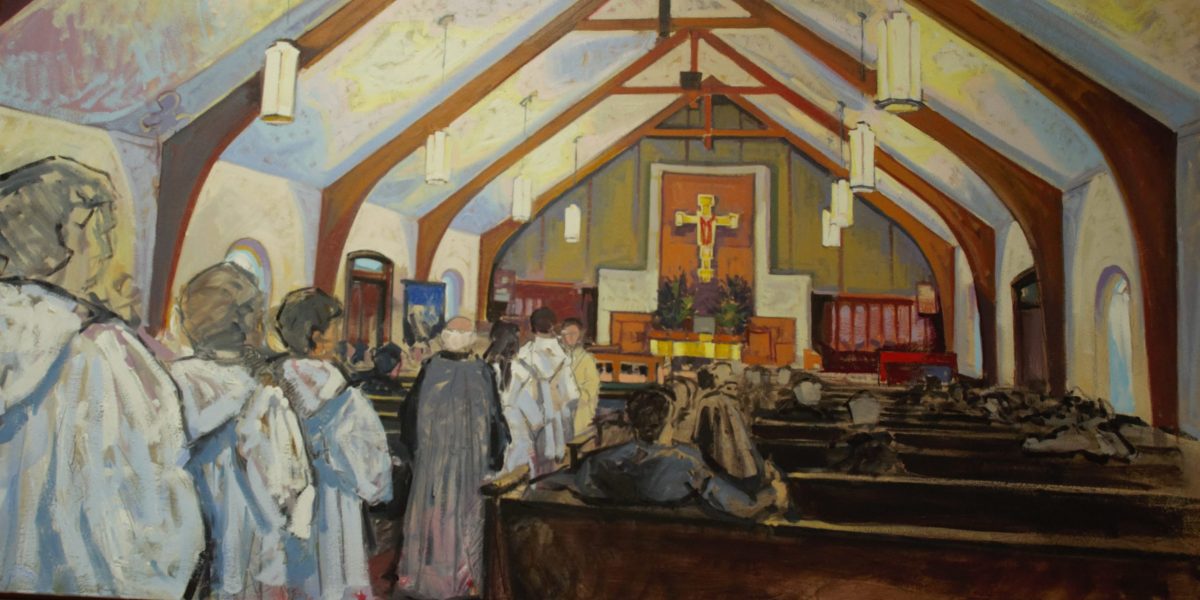
All are welcome to participate in our worship because it is in worship that we live out our life as a Christian family together. Scripture is the foundation of our worship. The service follows an order found in the Book of Common Prayer, two-thirds of which is scriptural. Every worship service includes the reading of Holy Scripture from the Old and New Testaments. Many of our prayers and hymns are filled with Scripture.
Our principle Sunday service is the Holy Eucharist. In the Holy Eucharist, we participate in the sacrament commanded by Christ, for the continual remembrance of his life, death, and resurrection, until his coming again. The Holy Eucharist is a sacrament in that it is an outward and visible sign of Christ’s grace and love. The Holy Eucharist is a communal liturgy, everyone is called to participate in worship. Each person is an important part of the worship experience.
We use all of our senses in worship as we offer our whole selves to God. We use our hearing to hear Scripture. We see the beauty of our church. We feel the wood of the pews and Altar rail. We may smell the fragrant offering of incense. We taste the bread and wine that is Christ’s body and blood. Worship in the Episcopal Church is a whole-body experience that calls us closer to God.
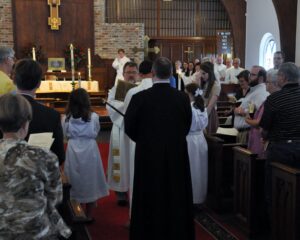 You will notice that those who are serving in worship are wearing strange clothing. These robes are called Vestments. Vestments are clothing that are set aside for worship. Vestments focus our attention on the act of worship and not on the individuals leading worship. Vestments have been worn in worship since as early as the 4th century. They are a tradition that the Church has retained to remind us of the sacramental nature of worship.
Beauty is also a part of the liturgy. Altar flowers remind us of the beauty of God’s creation. Music and singing add beauty to the service as we lift our voices up to God and give glory to God. Those serving in the liturgy wear Vestments that not only add beauty but also remind us that our worship is not about us, but about God. Our Vestments are a part of the worship experience that helps us to focus our attention on the act of worship.
We participate in such a way during worship to show reverence to God through with our actions. There are times during the liturgy when we stand, kneel, and sit. We also show reverence the presence of Christ by bowing our heads at certain times during the service, such as when the Processional Cross goes by, at the name of Christ, and when we approach the Altar.
If you are new to liturgical worship, at first worship may seem unusual and hard to follow. This is normal. Just know that if you have questions, just ask. We will be honored to help you. Over time as you grow in your journey with Christ in the church, worship will become familiar and comforting to you.
All Saints’ follows the Liturgical Calendar. This is the calendar of the Church year. This calendar reminds us of important days throughout the year. These important days are referred to as Feasts Days and Fasting Days. This calendar guides us through the year so that we may remember and celebrate important events in the life of Jesus Christ and the Church. The Liturgical Calendar may be found in the Book of Common Prayer. All Saints’ may observe Feast or Fast days, that do not fall on a Sunday, with a special service.